Microplastics in your blood, heart, brain and sperm: what the studies show
Peer-reviewed research has now found plastic particles deep inside the human body. Here is what was found, what it may mean, and how to cut what you drink.
The short answer
Yes, plastic is inside us. Studies have found it in human blood, in artery plaque, where it was linked to a 4.5 times higher risk of heart attack, stroke or death, in brain tissue, in testes and in semen. The harm is not yet proven to be caused by the plastic, but the evidence is building fast.
Ten years ago, microplastics were an ocean problem: fragments in fish and on beaches. Today scientists are finding them inside people. Not just passing through the gut, but lodged in the bloodstream, in the walls of arteries, in the brain, in the testes and in semen. Each discovery has come from a peer-reviewed study, and each has made the question more urgent: what is all this plastic doing inside us?
What are microplastics and nanoplastics?
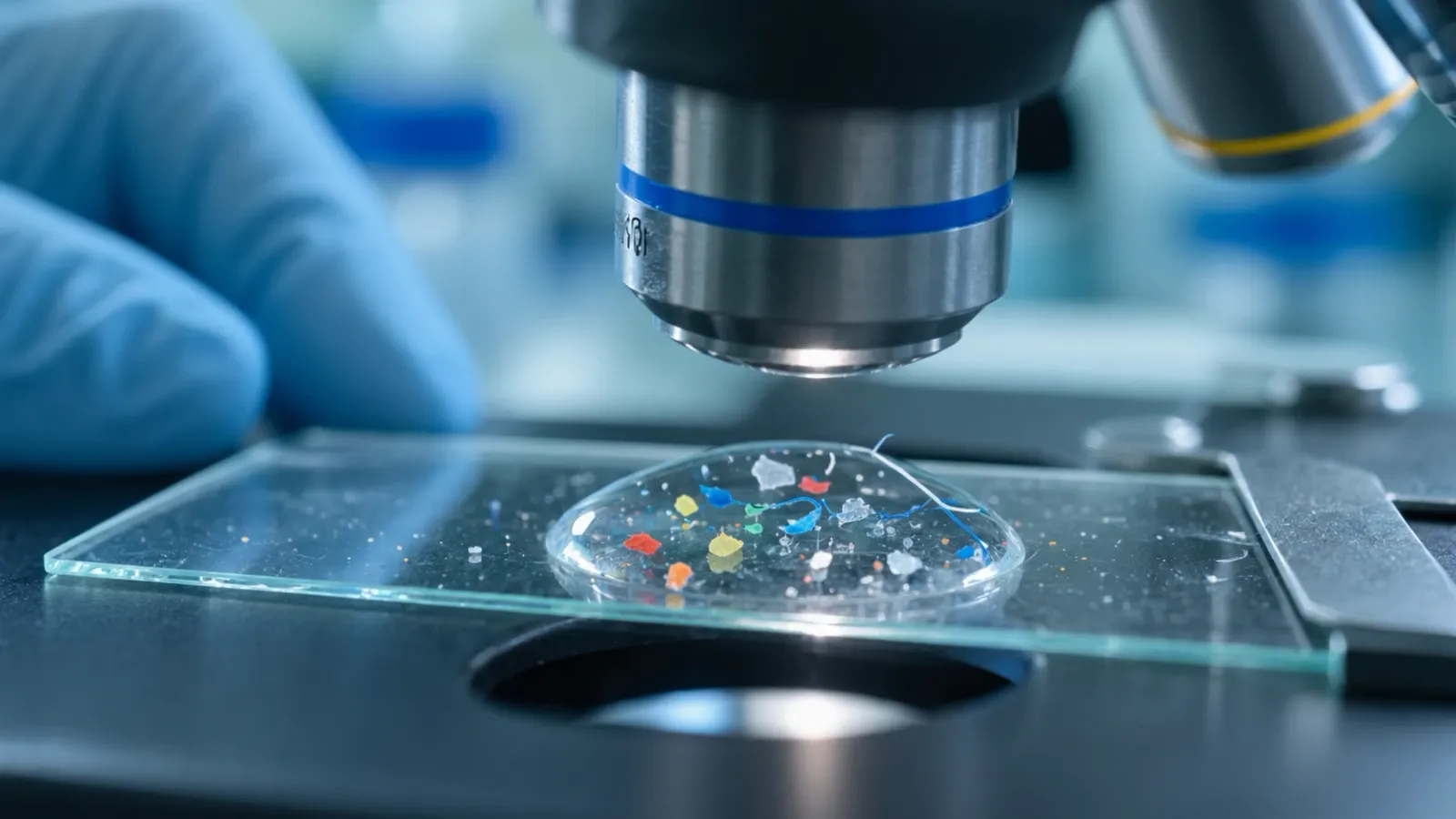
Microplastics are pieces of plastic smaller than 5 millimetres, shed as bottles, packaging, synthetic clothing and tyres break down. Nanoplastics are the smallest of them, under one micrometre, about a hundredth of the width of a human hair. That size is what worries researchers: particles that small can cross barriers in the body that larger ones cannot.
Where they have been found in the human body
In the blood
Researchers in Amsterdam tested the blood of 22 healthy volunteers and found measurable plastic in 17 of them[1]. The most common types were PET, used in drinks bottles, polyethylene, used in plastic bags and packaging, and polystyrene. The average was 1.6 micrograms of plastic per millilitre of blood.
This was the first proof that plastic particles get into the bloodstream, and the bloodstream reaches every organ. The authors stressed that the sample was small and that what the particles do once there is still unknown.
In the arteries, linked to heart attack and stroke
Doctors in Italy examined the fatty plaque removed from the neck arteries of 257 patients and followed them for an average of 34 months[2]. Plastic, mostly polyethylene, was found in the plaque of 58% of them, and under the electron microscope it showed up as jagged foreign particles inside the plaque’s immune cells. Patients with plastic in their plaque were about 4.5 times more likely to have a heart attack, a stroke or to die during the study than patients without it.
This is the strongest health signal yet. It is an association: the study does not prove that the plastic caused the heart attacks and strokes, and other factors may explain part of it, as the authors themselves note. But an accompanying editorial in the same journal called it a breakthrough discovery.
In the heart itself
A 2023 pilot study in Beijing analysed heart tissue taken from 15 patients during heart surgery and found microplastics, of eight different plastic types, in the tissue[3]. The authors found evidence that some particles were introduced during the operation itself, so not all of it came from everyday exposure. But it shows that plastic can lodge in the heart muscle and surrounding tissue.
In the brain
Analysing tissue from people who had died, a team at the University of New Mexico found plastic in the brain at higher levels than in the liver or kidney, mostly as tiny shard-like nanoparticles of polyethylene[4]. Levels in brain and liver samples were higher in 2024 than in 2016. Brains of people who had been diagnosed with dementia contained more plastic, with deposits in the walls of blood vessels and in immune cells.
Again, this shows where plastic is found, not what it does. The dementia finding may reflect damage that lets more plastic in, rather than plastic causing the damage. What the study does make clear is that the brain is not protected from it, and that the amount is rising.
In the testes and in semen
Researchers measured microplastics in 23 human testes and 47 dog testes and found plastic in every single one[5]. Human samples held almost three times as much as the dogs’, about 330 micrograms per gram of tissue on average. In the dogs, whose sperm could be counted, higher levels of PVC plastic were linked to lower sperm counts.
A separate study in Italy found microplastic fragments in the semen of six out of ten young men[6]. Neither study proves that plastic lowers fertility in men; the human testes came from post-mortem samples, so their sperm could not be counted. But together they show that plastic reaches the organs that make sperm, and the sperm itself.
In the placenta
In 2021, researchers in Rome found microplastic fragments in four of six placentas they examined, on both the mother’s and the baby’s side[7]. It was a small study, but it means exposure can begin before birth.
Why scientists are worried
The concern is not one study but the pattern. Plastic is now being found in the blood that carries it, the organs it reaches and the cells that are meant to clear it, and in the brain, levels were higher in 2024 than in 2016[4]. Particles have been seen inside immune cells in artery plaque[2], which is the kind of place where inflammation drives disease. And plastics carry chemical additives of their own.
At the same time, it is important to be clear about what is not yet known. In 2019, the World Health Organization judged the risk from microplastics in drinking water to be low at the levels then measured, while saying the evidence was weak and calling for more research[12]. Much of the research above has been published since then, and none of it yet proves that plastic causes disease in people. What it shows is enough to make reducing exposure a sensible precaution.
How microplastics get into you, in Bangladesh
We take in plastic through what we eat, what we breathe and what we drink. Drinking water is one of the easiest of those to do something about, and the Bangladeshi studies show why it matters here:
- Tap water: supplied tap water in four major cities contained microplastics in every sample, at an average of 35.33 particles per litre[8], a level the authors describe as higher than in other countries.
- Bottled water: all 10 brands tested contained microplastics, at about 35 particles per litre on average[9]. A US study using a more sensitive method found around 240,000 particles per litre in bottled water, most of them nanoplastics[11].
- Groundwater: drinking water from wells in six coastal districts contained microplastics at every site, at an average of about 25 particles per litre[10].
How to cut the plastic you drink
- Filter your drinking water. A membrane filter physically holds back particles. Hydra’s filter was tested in BUET laboratories for 99% removal of microplastics.
- Refill instead of buying single-use bottles. Bottled water is not plastic-free, and every bottle adds to the plastic in the environment that ends up back in water.
- Keep plastic away from heat. Don’t leave plastic bottles in a hot car or in the sun, and don’t heat food or drinks in plastic containers.
- Choose glass or steel to carry water. An insulated stainless steel bottle keeps water cool without a plastic body.
The bottom line
In just a few years, science has gone from asking whether plastic gets inside us to finding it in our blood, arteries, brains, testes and semen, and linking it, in one major study, to heart attacks and strokes. The final word on harm is not in yet. But you do not need to wait for it to drink cleaner water.
Questions people ask
Are there microplastics in Bangladesh’s tap water?
Yes. A 2024 study of supplied tap water in four major Bangladeshi cities found microplastics in every sample, at an average of 35.33 particles per litre, mostly fibres.
Does bottled water contain microplastics?
Yes. Ten bottled-water brands sold in Bangladesh all contained microplastics, at about 35 particles per litre on average. A 2024 US study using a newer method counted around 240,000 plastic particles per litre of bottled water, about 90% of them nanoplastics.
Can microplastics reach the brain?
A 2025 study in Nature Medicine found plastic, mostly tiny shard-like nanoparticles, in human brain tissue at higher levels than in the liver or kidney, rising between 2016 and 2024. Brains of people with dementia held more. That is an association; the study did not show the plastic caused dementia.
Do microplastics affect fertility?
Microplastics have been found in every human testis tested in a 2024 study and in the semen of six of ten men in another. In the dog samples from the 2024 study, more PVC plastic was linked to lower sperm counts. A direct effect on human fertility has not been proven.
Does Hydra remove nanoplastics?
Hydra’s filter was tested in BUET laboratories for 99% removal of microplastics. Nanoplastic removal has not been tested separately, so we do not claim it.
Sources
- Leslie HA, van Velzen MJM, Brandsma SH, et al. (2022). Discovery and quantification of plastic particle pollution in human blood. Environment International 163:107199.
- Marfella R, Prattichizzo F, Sardu C, et al. (2024). Microplastics and Nanoplastics in Atheromas and Cardiovascular Events. New England Journal of Medicine 390(10):900–910.
- Yang Y, Xie E, Du Z, et al. (2023). Detection of Various Microplastics in Patients Undergoing Cardiac Surgery. Environmental Science & Technology 57(30):10911–10918.
- Nihart AJ, Garcia MA, El Hayek E, et al. (2025). Bioaccumulation of microplastics in decedent human brains. Nature Medicine 31:1114–1119.
- Hu CJ, Garcia MA, Nihart A, et al. (2024). Microplastic presence in dog and human testis and its potential association with sperm count and weights of testis and epididymis. Toxicological Sciences 200(2):235–240.
- Montano L, Giorgini E, Notarstefano V, et al. (2023). Raman Microspectroscopy evidence of microplastics in human semen. Science of the Total Environment 901:165922.
- Ragusa A, Svelato A, Santacroce C, et al. (2021). Plasticenta: First evidence of microplastics in human placenta. Environment International 146:106274.
- Hossain MB, Yu J, Sarker PK, et al. (2024). Microplastic accumulation, morpho-polymer characterization, and dietary exposure in urban tap water of a developing nation. Frontiers in Sustainable Food Systems 8.
- Hossain MB, Yu J, Banik P, et al. (2023). First evidence of microplastics and their characterization in bottled drinking water from a developing country. Frontiers in Environmental Science 11.
- Paray BA, Yu J, Sultana S, et al. (2024). Contamination, morphological and chemical characterization, and hazard risk analyses of microplastics in drinking water sourced from groundwater in a developing nation. Frontiers in Environmental Science 12.
- Qian N, Gao X, Lang X, et al. (2024). Rapid single-particle chemical imaging of nanoplastics by SRS microscopy. Proceedings of the National Academy of Sciences 121(3).
- World Health Organization (2019). Microplastics in drinking-water. WHO.
Written by Nawfel Ahamad, a chemical engineering graduate of BUET and co-founder of Hydra. This guide is general information, not medical advice. If you are unsure about a water source, ask a health professional or ask us before you drink from it.